 With sustained local transmission of COVID-19 and the implementation of strict quarantine protocols (ECQ), the operations of companies across all Philippine industries have been greatly affected. The outbreak triggered the cessation of normal business operations and is estimated to induce a total of around Php 276.3 Billion to Php 2.5 Trillion worth of losses in economic output, depending on the progress of the virus’ containment.
An estimated 1.6 million small businesses are affected and nearly 30% of which are forced to stop operations entirely. With the expected increase in unemployment, the National Government approved the Small Business Wage Subsidy Program – a provision for one-time financial assistance amounting to Php 5,000 – Php 8,000 each for approximately 3.4 million workers affected by the quarantine, allowing them to purchase basic necessities.
In terms of the overall economy, business closures are expected to significantly impact this year’s gross domestic product (GDP), as there is an estimated loss of Php 429 Billion to Php 1.36 Trillion in gross value added, accounting for 2.1% to 6.6% of the year’s nominal GDP.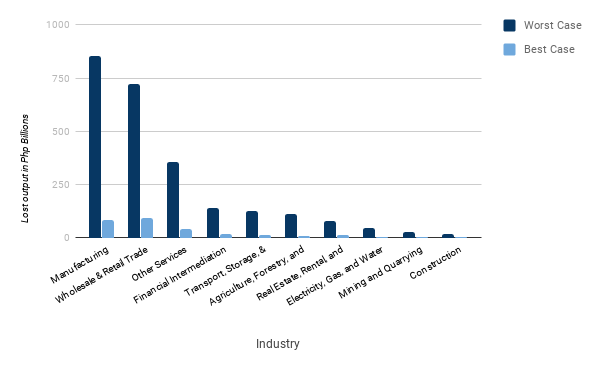
Figure 1: Forecasted Losses per Industry due to COVID-19 (in Php Billions)
Source: Businessworld Research
Table 1: Forecasted Losses per Industry due to COVID-19 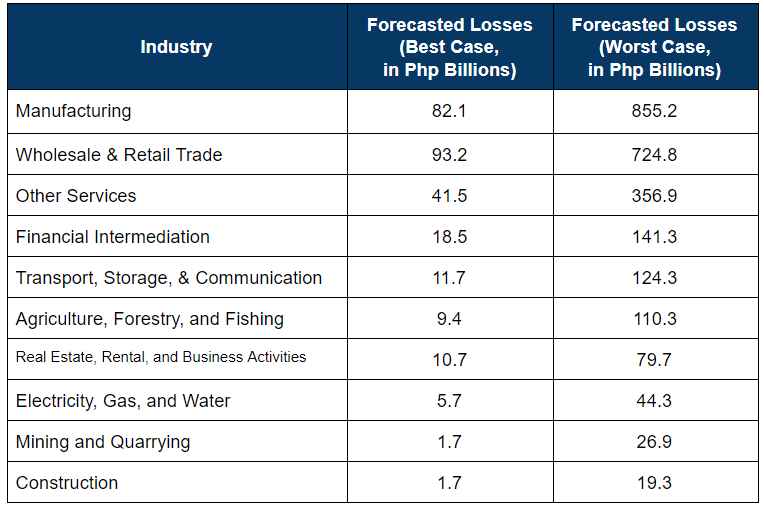
Source: Businessworld Research
Figure 1 illustrates the potential losses in economic output per Philippine industry. Estimates are determined based on two scenarios: the best case implies that the virus is contained in the shortest possible time, while the worst-case suggests otherwise.
Unemployment on the Rise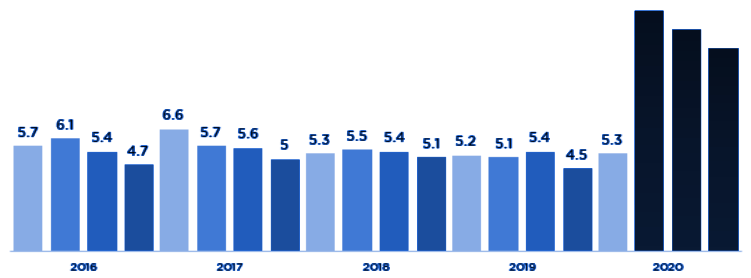
Figure 2: Philippine Unemployment Rates from 2016 – 2020
Source: Trading Economics Philippine Unemployment
Before the outbreak and eventual lockdown, the country’s unemployment rate was at its historical low of 5.1% (PSA, 2020), while in the last five years, unemployment ranged between 4.5% to 6.5%. According to the National Economic and Development Authority (NEDA) and the former Socioeconomic Planning Secretary, the financial crisis brought about by the pandemic could bring unemployment back to double-digits.
Manufacturing and Supply Chain Sector
The Philippine Economic Zone Authority (PEZA) announced the closure of 700 factories in Luzon as a precautionary measure. Subsequently, not all workers were provided with financial assistance and some were forced to take leaves without pay. This cessation of factory operations is expected to affect the country’s standing on exports, considering that the country’s largest trading partner (accounting for 35% of total exports) is China, where the first outbreak of COVID-19 occurred. Partial customs data for February already indicate that total exports to China are down by 55%.
With the imposed Luzon-wide lockdown, 36,800 twenty-foot equivalent units (TEU) of imports remain unclaimed at the Manila International Container Terminal – 66% higher compared to the 22,000 TEU of unclaimed imports before the quarantine. This accumulation of cargo in the container terminals poses a risk to the supply chain and will eventually prevent the manufacturing industry from maintaining efficient operations.
Prior to the pandemic, businesses retrieve approximately 4,000 cargo shipments per day from the Manila International Container Port, but it was reduced to 1,600 containers per day upon the implementation of the lockdown. Despite the yard operating at 98% capacity, problems in mobility and transport hinder movement in the trading sector and have paralyzed the manufacturing industry.
Service Sector
The country’s economic growth is mainly reliant on supplying the service demand of foreign enterprises. The Philippine service sector accounts for more than half of the country’s GDP. Although not as heavy a contributor compared to the service sector, manufacturing is considered to be a relatively durable industry as it has comprised a quarter to a fifth of the country’s GDP since the 1980s.
Unlike the manufacturing sector, the service sector has the flexibility for work to be adapted to the homes of employees. Early April, almost a month into the lockdown, the Inter-Agency Task Force for COVID-19 permitted BPO companies and other export-oriented establishments to proceed with setting up equipment for work-from-home employees. This gives a cushioning effect as this greatly minimizes the possible losses the sector could face during the lockdown, unlike the complete shutdown that the manufacturing sector is currently facing.
Automation & Artificial Intelligence – The Solution for Businesses Intra & Post-Pandemic?
In the aftermath of this pandemic, the manufacturing industry, specifically those with large-scale production processes, will greatly benefit from the shift toward automation. The International Federation of Robotics reported that robot production costs and the worldwide supply of industrial robots are continuously increasing, a possible opportunity for wide adoption (as seen in Figure 3 below). 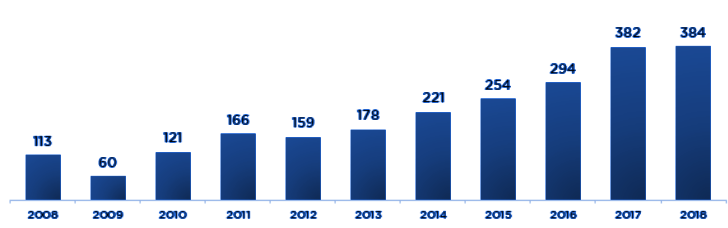
Figure 3: Estimated Worldwide Supply of Robots (in thousands)
Source: International Federation of Robotics
The benefits of automation are more easily realized during the crisis. According to Shivaji Das, Managing Director of consultancy firm Frost & Sullivan, the COVID-19 outbreak is only expected to accelerate the shift to automation. McKinsey also stated that automation and artificial intelligence are expected to lift productivity and economic growth, but will result in millions of employees worldwide needing to switch occupations or upgrade skills.
According to the study by Cisco and Oxford Economics, the movement in automation technology will displace about a million Filipino jobs. The landscape of the Services Industry, however, can be adjusted so that A.I. can become what it was intended for, a tool to enhance capacity, rather than a harbinger of obsolescence. By training workers for the use of new technologies, instead of replacing them with machines, businesses could also exponentially improve their capacities. This would allow for increased productivity, with the same number of people.
The IT-BPM industry can be expected to have less troubles recovering from the crisis given the fact that already 50-60% of contact operations in the Philippines are automated, and therefore require less human employment to operate. The industry also sees the potential reduction of operating expenses by more than half as a result of automation.
As reported by Accenture, Inc., one of the top IT-BPM companies operating in the Philippines, the implementation of A.I. can also increase revenues by 38% and employment by 10%. Business leaders in the sector also see this as an opportunity to enhance their workers. On a wide-scale, this would produce an industry-wide correcting effect.
The main downside of the inclusion of automation and artificial intelligence in the labor market is the uncertainty that millions of people might be displaced, assuming that automation will take over for the workers. But the infusion of technology also protects and promotes the safety of the workers, since it minimizes the exposure of workers to bio-hazards and hazardous chemicals, depending on the nature of work, and at the same time it lifts the production numbers while under a crisis.
Automation in the manufacturing and services sector comprises a wide array of uncertainties in its implementation for the labor force. The main challenge for the founders, investors, and policymakers is to minimize the adverse effects of automation for the people while attempting to sustain economic growth and to achieve production goals amid the pandemic.
Written by: Fred Mejia
References:
[3] https://newsinfo.inquirer.net/1245942/lockdown-shutters-700-luzon-factories
[7] https://www.philstar.com/headlines/2020/04/13/2006958/new-protocols-out-bpo-workers
[8] https://www.bworldonline.com/coronavirus-may-cost-phl-up-to-p2-5-trillion-in-economic-output/
[9] https://tradingeconomics.com/philippines/unemployment-rate
[10]https://newsinfo.inquirer.net/1248040/double-digit-unemployment-rate-feared-due-to-covid-19-crisis
[14]https://asia.nikkei.com/Spotlight/Coronavirus/Coronavirus-a-threat-to-vital-Philippine-call-centers
[15] https://business.inquirer.net/266682/automation-ai-seen-killing-more-ph-jobs
[16] https://mycebu.ph/article/ai-accenture-report/
________________________________
Aviso Valuation and Advisory Corp. is a real estate consultancy firm that offers valuation and business advisory services compliant to international standards such as the International Valuation Standards (IVS) and International Financial Reporting Standards (IFRS). To assure that we only produce high-quality deliverables, as needed, we do tasks beyond the usual appraisal process like verifying pertinent property documents (i.e. land titles, tax declarations, etc.) with the appropriate government agencies for due diligence purposes prior the acquisition of the properties.