Written by: Mary Grace C. Ladringan
On June 4, 2026, PAGASA officially declared the onset of the rainy season as the Southwest Monsoon—the habagat—brought occasional to frequent rainfall across the western sections of Luzon and the Visayas. The agency warned that nine to 13 tropical cyclones could form or enter the Philippine Area of Responsibility between June and November, with El Niño conditions potentially amplifying monsoon rains over western Luzon.¹ For Metro Manila, the declaration was less a weather update than a countdown. The rains will come. The question, yet again, is whether the city is ready.
It is not. And the evidence is structural, not seasonal.
As early as August 2025, former DPWH Secretary Manuel M. Bonoan confirmed before a House committee what flooding residents had long suspected: Metro Manila has no drainage master plan. That admission — issued in the middle of a flooding crisis triggered by consecutive tropical storms and the monsoon — remains unresolved heading into the 2026 wet season. With the habagat now active and typhoons on the horizon, the urgency of addressing Metro Manila’s failure in drainage governance has never been greater.
A System Built for a Smaller City
Metro Manila’s drainage infrastructure was largely built in the 1970s—for a far smaller population. Since then, the National Capital Region has grown to over 13 million people, but its drainage network has not kept pace.
Secretary Bonoan has confirmed that nearly 70% of the capital region’s drainage network can no longer channel floodwaters to pumping stations, even though these facilities remain fully operational. “The pumping stations are working. The problem is, floodwaters can’t flow to them because the drainage system is not adequate to convey floodwaters,” Bonoan said, noting the system is outdated and heavily silted.¹
With a Metro Manila population of approximately 15 million, the region generates an estimated 15 million kilograms of trash daily — much of it ending up in waterways, drainage systems, and pumping station inlets.³
The Cost of Inaction
Table 1. Key Indicators — Metro Manila Drainage and Flood Finance
|
Indicator |
Value | Source |
|
Internal drainage operating at capacity |
~30% | DPWH, 2025 |
|
Drainage system silted/blocked |
~70% |
DPWH, 2025 |
|
2025 estimated direct flood damage (Metro Manila) |
₱41–₱55 billion | IRDF, 2025 |
|
DPWH flood control budget (2025) |
₱254.29 billion |
NEP, 2025 |
| Total flood control allocation (2023–2025) | ~₱980.25 billion |
GMA News Research |
| Budget utilization rate (2023) | 58% |
COA Audit |
| Losses from Typhoons Ondoy & Pepeng (2009) | US$4.4 billion |
World Bank / GFDRR |
The DPWH’s flood budget has grown from ₱42.2 billion in 2015 to ₱254.29 billion in 2025 — a six-fold increase. According to Senator Joel Villanueva, the government is spending ₱1.4 billion a day on flood control programs, and yet that massive cost is nowhere being felt by ordinary Filipinos.⁴
In Metro Manila alone, ₱52.66 billion was earmarked for flood mitigation in 2025, but the region still incurred ₱41–₱55 billion in direct damages—encompassing damage to public infrastructure, residential and commercial properties, transportation systems, and health expenditures due to waterborne diseases and displacement.⁵ Budget utilization rates have also deteriorated; COA audit reports flagged that DPWH was unable to efficiently implement 17 ODA-funded projects, including the Pasig-Marikina River Channel Improvement Project and the Metro Manila Flood Management Project, with negative physical slippages ranging from 0.78% to 36.60%.⁶
Why a Master Plan Matters
A drainage master plan coordinates system mapping, hydrological modeling, infrastructure sizing, inter-agency mandates, and long-term maintenance. Without one, investments remain fragmented and reactive—driven by congressional insertions rather than engineering logic.
The World Bank has consistently linked integrated planning to climate resilience. The project documentation for the Pasig-Marikina River Basin Flood Management Project notes that the number and intensity of typhoons appear to be increasing, with cumulative damage costs nearly tripling from 2006–2010 to 2011–2015.⁷ The ADB identifies the Philippines as among the countries facing long-term and repetitive damage from extreme weather—making drainage planning a developmental imperative, not merely a public works issue.⁸
Government Response
MMDA General Manager Procopio Lipana confirmed that the MMDA and DPWH are now crafting a 50-year drainage master plan, modeled after the Netherlands’ approach—a system designed after 50–60-year drainage master plans that project rainfall based on weather patterns 30 to 50 years forward, then adjust infrastructure accordingly.⁹ MMDA Chairman Artes disclosed the plan will be funded by the World Bank.¹⁰
DBM Secretary Pangandaman has initiated convergence budgeting discussions—coordination across DPWH, MMDA, DILG, and local governments—to pool resources behind the plan.² However, precedent warrants caution. A P351-billion flood management master plan approved under the Aquino administration in 2012 has seen less than 30% of its components implemented as of 2025.¹¹ Past underperformance underscores that planning ambition must be matched by implementation governance.
Comparative Lessons
Table 2. Flood Master Plan Approaches in Selected Asian Cities
|
City |
Planning Horizon | Key Features |
Outcome |
|
Jakarta |
Revised since 1973 | Dual flood canals, deep tunnels, reservoirs | Floods persist; governance fragmentation a key constraint |
|
Bangkok |
30+ year phased plans | Extensive canals, floodgates, pumping stations | 2011 floods caused US$4B losses, accelerating reform |
| Netherlands (model) | 50–60 year rolling plan | Climate-projected rainfall, adaptive design |
Benchmark for MMDA’s proposed master plan |
| Metro Manila | None (as of Aug 2025) | Fragmented, reactive investments |
70% blockage; ₱41–55B in annual damage |
Jakarta’s experience is instructive: a Dutch engineering team published a master plan for drainage and flood control as early as 1973, leading to the construction of the West and East Flood Canals—yet governance fragmentation and inadequate maintenance kept Jakarta flood-prone for decades.¹² The lesson: a master plan must be paired with legal enforcement against illegal structures, durable institutional arrangements, and predictable maintenance financing.
Implications for Real Estate Markets and Property Valuation
Metro Manila’s drainage governance failure is not only a public infrastructure problem—it is a persistent and measurable drag on property markets. Flood risk directly suppresses land values, constrains investment, elevates insurance costs, and distorts the spatial distribution of real estate demand across the metropolis. For practitioners of real estate valuation, highest and best use analysis, feasibility assessment, and transit-oriented development planning, the absence of a coherent drainage master plan introduces structural uncertainty that current valuation frameworks must explicitly address.
Table 3. Flood-Resilient vs. Flood-Exposed Areas, Metro Manila (Q1 2026)
|
Area / District |
Flood Risk | Drainage Infrastructure | Valuation Note |
|---|---|---|---|
|
BGC, Taguig |
Very Low | Underground detention tank; 22,000 m³ capacity | Benchmark premium; resilience infrastructure fully priced in |
| Rockwell, Makati | Low | Elevated terrain; private estate drainage |
Ultra-luxury ceiling; resilience commands sustained scarcity premium |
| Ortigas CBD, Pasig / Mandaluyong | Moderate–High | Aging public drainage; partial river exposure (Manggahan Floodway) |
Flood risk factored as negative adjustment in sales comparison; HBU constrained |
| CAMANAVA (Caloocan, Malabon, Navotas, Valenzuela) | High | Tullahan River exposure; 70%+ drainage blockage in NCR-wide system |
Significant flood risk discount; insurance surcharges add to holding cost |
| Marikina River Corridor | Very High | River channel improvement ongoing (Phase IV); dependent on DPWH completion |
Post-Ondoy value depression persists; upside contingent on infrastructure delivery |
Sources: MMDA Flood Hazard Zones; DPWH (2025); GMA News Online (2024).
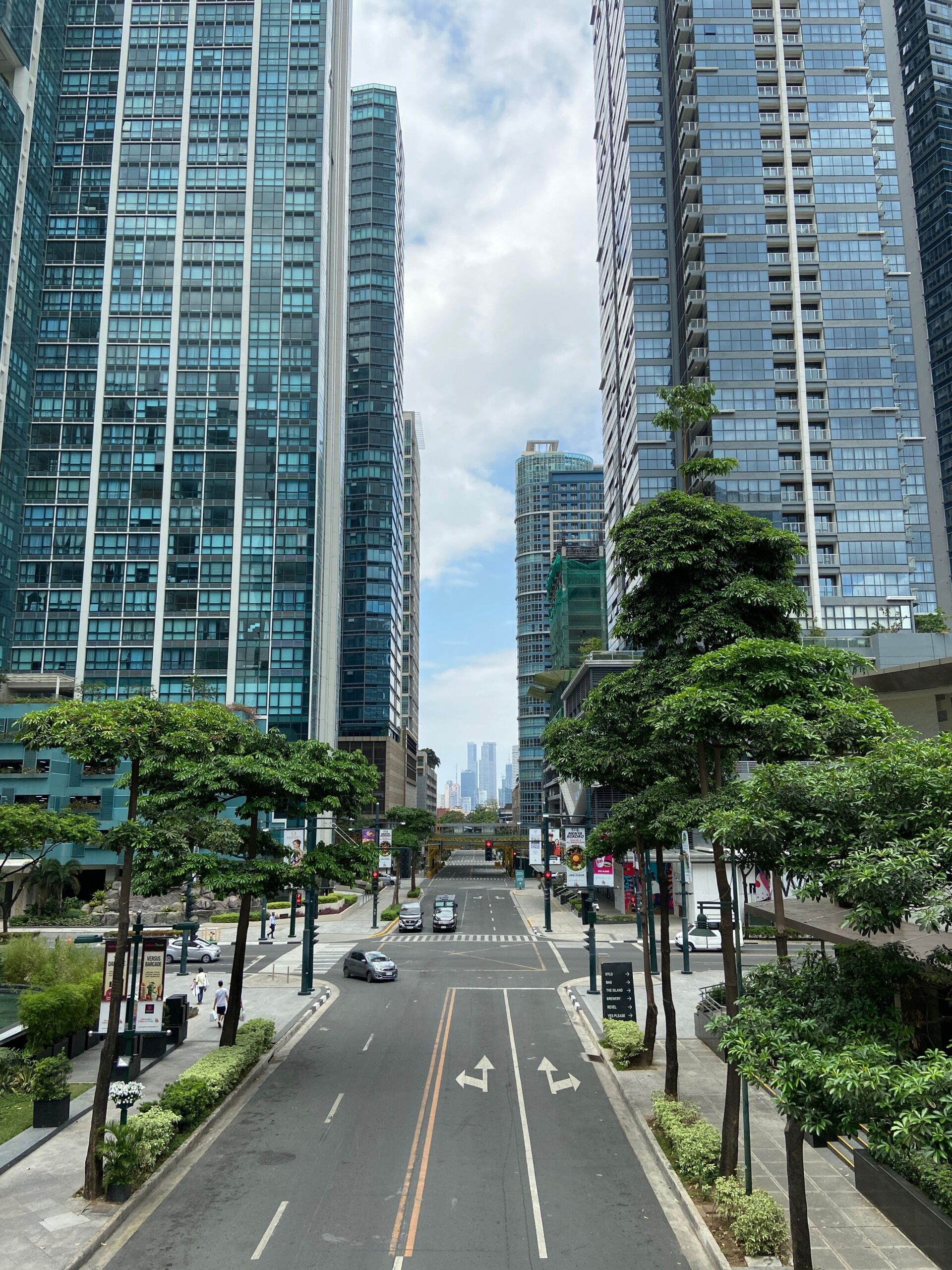
Bonifacio Global City
BGC’s flood-resilience premium is not incidental; it is the direct result of planned, privately financed drainage infrastructure integrated into the development’s masterplan by the Bases Conversion and Development Authority and Fort Bonifacio Development Corporation. DPWH Secretary Bonoan has acknowledged the government is seeking to replicate BGC’s underground impounding system elsewhere in Metro Manila but has been unable to identify suitable locations.¹⁸ The BGC case constitutes a proof of concept: where drainage infrastructure is engineered to a sufficient standard, real estate markets respond with sustained value premiums that remain durable across cyclical downturns.
The Infrastructure-Value Nexus: What the Evidence Shows
The relationship between flood protection infrastructure and property value creation is documented in the World Bank’s policy research literature. A 2021 World Bank working paper on flood protection and land value creation found that flood mitigation investments yield the highest land value returns where land is most valuable — precisely the conditions applicable to Metro Manila’s central business districts.¹⁹ The paper proposes reduced-form expressions for calculating land value creation potential from flood mitigation works, directly applicable to feasibility and highest-and-best-use analysis.
More broadly, a 2019 World Bank cost-benefit analysis of resilient infrastructure found that strengthening infrastructure assets in low- and middle-income countries yields a benefit-cost ratio exceeding 2.0 in 77% of modeled scenarios and exceeding 4.0 in half of them—with climate change effectively doubling the median benefit-cost ratio over time.²⁰ A separate Harvard Kennedy School study (2025) analyzing flood protection levees in the United States found that protected residential areas register home value increases of 3 to 4 percent, with benefits capitalized at the time of construction.²¹ Applied to Metro Manila’s residential stock—estimated at over 162,510 condominium units in the CBDs alone as of 2024—even a conservative 3% value uplift from credible drainage improvement would represent several hundred billion pesos in aggregate property wealth creation.²²
The secondary benefits of urban flood protection—beyond direct damage avoidance—include elevated investor confidence, reduced insurance premiums, enhanced workforce productivity from fewer disruptions, and expanded collateral values supporting mortgage and commercial lending.²³ A World Bank assessment of urban flood resilience projects using its Triple Dividend of Resilience framework found that secondary benefits, including property value uplift and economic activity gains, represent 12.7% of the net present value of project benefits under conservative modeling assumptions.²⁴ These are not notional benefits: they translate directly into assessable value under income-capitalization and discounted-cash-flow methodologies applied in Philippine real estate appraisal practice.
Metro Manila’s floods are not a meteorological problem—they are a planning and governance failure with quantifiable consequences. With a drainage system operating at 30% capacity, ₱41–55 billion in annual damage, and nearly ₱1 trillion spent on flood control over 15 years without commensurate results, the cost of further delay is well documented. The forthcoming 50-year drainage master plan, if properly designed, rigorously implemented, and insulated from political interference, offers the most credible path yet toward a Metro Manila that can withstand the floods to come.
__________________________________
Aviso Valuation and Advisory Corp. is a real estate consultancy firm that offers valuation and business advisory services that are compliant with international standards such as the International Valuation Standards (IVS) and International Financial Reporting Standards (IFRS). To assure that we only produce high-quality deliverables, as needed, we do tasks beyond the usual appraisal process like verifying pertinent property documents (i.e. land titles, tax declarations, etc.) with the appropriate government agencies for due diligence purposes prior to the acquisition of the properties.
References
¹ PAGASA Climate Outlook, June–November 2026.
² Manila Bulletin. (July 22, 2025). ‘Very old’ drainage system hampers Metro Manila flood control—DPWH.
⁴ Manila Bulletin. (August 3, 2025). MMDA, DPWH to finalize Metro Manila drainage master plan.
⁵ Inquirer Opinion. (July 24, 2025). Billions down the drain.
⁶ IRDF. (September 2025). Excessive Flooding in Metro Manila and Across the Philippines.
⁷ GMA News Online. (July 29, 2025). Nearly P1 trillion allotted for flood control projects from 2023–2025.
⁸ World Bank. (2020). Pasig-Marikina River Basin Flood Management Project (P171897). World Bank Group.
⁹ Asian Development Bank. (2019). Asian Development Outlook 2019: Strengthening Disaster Resilience. ADB, Manila.
¹⁰ GMA News Online. (July 31, 2024). MMDA, DPWH crafting 50-year drainage master plan.
¹¹ GMA News Online. (July 30, 2024). DPWH: 70% of NCR’s internal drainage clogged with garbage, silt.
¹⁸ GMA News Online. (August 1, 2024). Is a flood-free Metro Manila possible? Gov’t considers past proposals.
¹⁹ World Bank. (2021). Flood Protection and Land Value Creation: Not All Resilience Investments Are Created Equal. Policy Research Working Paper. World Bank Group.
²⁰ Hallegatte, S., Nicolas, C., Fox, C., Rozenberg, J., & Rentschler, J. (2019). Strengthening New Infrastructure Assets: A Cost-Benefit Analysis. World Bank Policy Research Working Paper No. 8896.
²¹ Bradt, J.T. & Aldy, J.E. (March 2025). Private Benefits of Public Investment: Climate Adaptation and Resilience. Harvard Kennedy School Faculty Research Working Paper.
²³ IRDF. (September 2025). Excessive Flooding in Metro Manila and Across the Philippines: Accrued Financial Benefits of Proper Implementation.
²4 World Bank Sustainable Cities Blog. (2024). Beyond Avoided Losses: Capitalizing on Secondary Benefits of Investments in Urban Flood Resilience. Citing Can Tho Urban Development and Resilience Project (Triple Dividend Framework).