Remote working, digital transactions, and business realigning are just a few of the changes that have taken place as the COVID-19 pandemic forced millions of workers to stay at home and restricted in-person business operations. Businesses used technology as a useful way of interacting with customers to introduce automation and faster processes, and so did the Government, to improve some of their traditional face-to-face transactions.
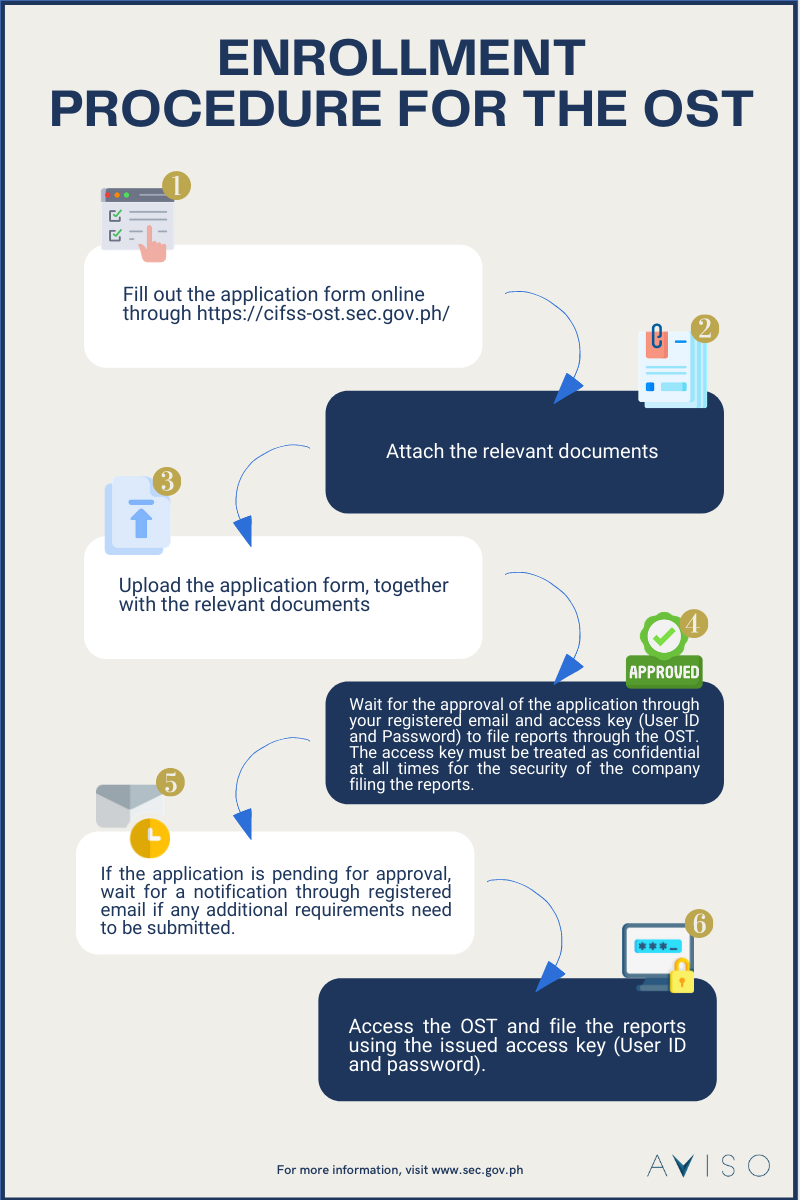
As the deadline for submission of Audited Financial Statements (AFS) approaches on April 15, the Securities and Exchange Commission (SEC) has issued SEC Memorandum Circular No. 3, series of 2021 to promulgate and provide guidelines on the filing of AFS, General Information Sheets (GIS), and other annual reports for the fiscal year 2021. The SEC also announced in the aforementioned Memorandum Circular that these reports will need to be submitted through the SEC’s Online Submission Tool (“OST”) which can be accessed through https://cifss-ost.sec.gov.ph/.
From March 15, 2021 to December 15, 2021, all stock corporations are required to enroll in the OST for the initial implementation. For the Non-stock corporations, they are given the option of whether they will (1) enroll and submit their reports through OST, (2) proceed to the SEC Kiosk for assistance in the enrollment process or (3) submit their reports over the counter. Nonetheless, by 2022, all corporations, whether stock or non-stock, will be required to enroll and submit their reports through the OST.
According to the SEC, this initiative intends to minimize in-person interactions, especially during the pandemic, automate business transactions, and to promote sustainable business practices.
“Beyond making it easier and more convenient for corporations to comply with their reportorial requirements, the OST should help our stakeholders become more comfortable with digital-based transactions, as we harness the full advantages of new technologies in improving our services,” SEC Chairperson Emilio B. Aquino said in a statement.
REQUIRED FORMAT FOR THE DOCUMENTS TO BE SUBMITTED
|
REPORT TO BE SUBMITTED |
FILE FORMAT |
| GIS – Unsigned form |
Multi-Page PDF with Text Layer of the accomplished but unsigned form |
| GIS – Unsigned and Notarized |
Multi-Page PDF High Resolution Scan (at least 100×100 dpi) of the document with the Signatories Page and the Notarization Page |
| Audited Financial Statement (AFS), duly signed by the auditor and all required signatories, together with the proof of filing with the BIR |
|
| Sworn Statement for Foundation (“SSF”) |
|
| General Form for Financial Statements (“GFFS”) |
Excel |
| Special Form for Financial Statements (SFFS), including IHFS, PHFS, BDFS, LCFS, FCFS, LCIF, and FCIF |
Excel |
| Affidavit of Non-Operation (ANO) attached to AFS/GIS |
|
| Affidavit of Non-Holding of Annual Meeting (ANHAM) attached to GIS |
|
DEADLINES
The deadline for filing the AFS of a stock corporation is determined by the last numerical digit of their SEC registration or license number, as shown in the schedule below:
|
LAST NUMERICAL DIGIT |
DEADLINE |
|
1 |
June 1 – 30 |
|
2 |
July 1 – 31 |
|
3 & 4 |
August 1 – 31 |
| 5 & 6 |
September 1 – 30 |
| 7 & 8 |
October 1 – 31 |
| 9 & 0 |
November 1 – 30 |
WHY CORPORATIONS ARE REQUIRED TO FILE THEIR AFS
AFS is a formal record of the financial activities and position of a business, person, or other entity – which is determined mostly by the value of assets they own.
Filing of AFS is a mandatory statutory requirement imposed by law and monitored by the Philippine regulatory agencies: BIR and SEC, to ensure that companies are practicing strong financial management and adhere to the local compliance requirements of the country or jurisdiction in which the company is registered.
Governments can also ensure a higher level of corporate governance and tax compliance within their jurisdiction by requiring companies to submit third-party-certified reports on their financial activities each year.
HOW AVISO CAN ASSIST COMPANIES PREPARE FOR THE AUDIT SEASON
The National Internal Revenue Code of 1997 as last amended by Republic Act No. 10653 Section 6(E) partially states that the Commissioner shall, upon consultation with competent appraisers, both private and public sectors, determine the fair market value of real properties, thus, to simplify the process.
Meaning, valuation helps in maintaining the accuracy of the asset values stated in the financial statements. Assets usually do not have the same value from the day it was purchased. As part of the asset valuation process, a percentage of their value must be deducted for depreciation (usually for fixed assets) and increased for capital appreciation (usually for land assets).
It can also save time, money, and effort for your company as it helps you avoid misstatements of asset values in your reports and its corresponding penalties – thus making Financial Reporting as efficient as it could ever be.As a part of our advocacy in assisting other companies with their financial reporting requirements, we highly recommend the use of asset valuation to ensure the accuracy of financial reports. If you want to learn more about valuation and how it can help you save time, effort, and resources when preparing your Audited Financial Statement, email us at info@askaviso.com or call us at +63 917 621 4649 and +63 917 652 7648.
Written By: Mary Grace Ladringan and Angelo Gandia
Aviso Valuation and Advisory Corp. is a real estate consultancy firm that offers valuation and business advisory services compliant to international standards such as the International Valuation Standards (IVS) and International Financial Reporting Standards (IFRS). To assure that we only produce high-quality deliverables, as needed, we do tasks beyond the usual appraisal process like verifying pertinent property documents (i.e. land titles, tax declarations, etc.) with the appropriate government agencies for due diligence purposes prior to the acquisition of the properties.