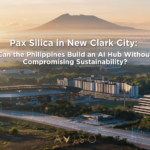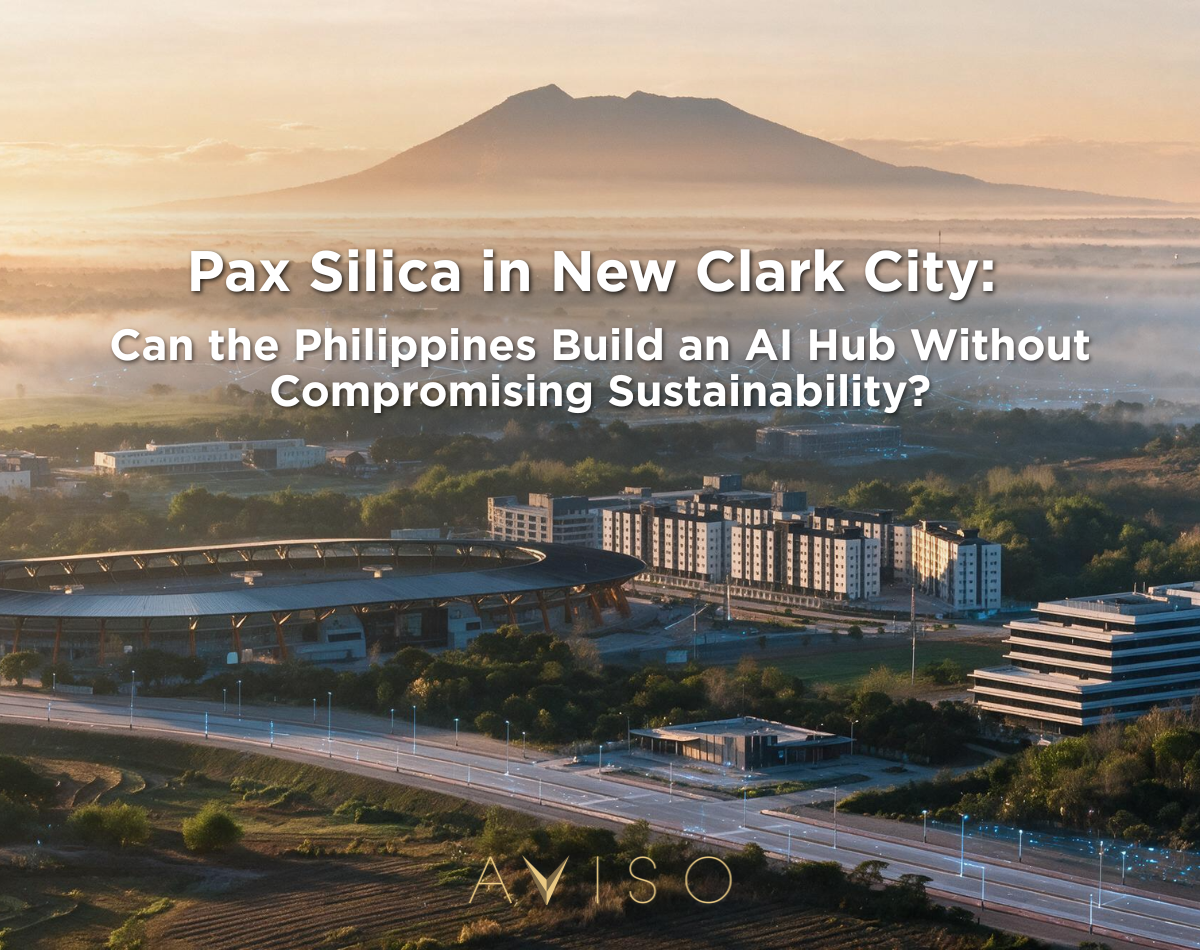
In April 2026, the Philippines became the 13th signatory to Pax Silica, a US-led coalition — now roughly two dozen members strong — built around securing allied supply chains for AI, semiconductors, and critical minerals. Its centerpiece is a 4,000-acre (~1,620-hectare) Economic Security Zone (ESZ) at New Clark City, Capas, Tarlac, designated the initiative’s first “AI-native” industrial acceleration hub.
The Bases Conversion and Development Authority (BCDA), which manages the site, projects an initial $10-billion investment scaling to $40 billion–$70 billion at full buildout; 130,000–190,000 direct jobs and 500,000–800,000 indirect jobs; up to $200 billion in cumulative exports by roughly 2058; and ₱68 billion–₱75 billion a year in tax revenue at maturity. The first 500-hectare phase targets 2028 construction, with a framework agreement expected in November 2026.
The economic case is genuinely significant. So is the resource question this article treats as the organizing test of the project’s viability: can Central Luzon absorb an industrial ecosystem of this scale without straining the power grid, the water table, and the farmland that feeds it?
Not (only) a data-center story
Public debate has tended to conflate Pax Silica with hyperscale data centers. BCDA officials describe the zone instead as an integrated district for semiconductor packaging, electronics manufacturing, mineral processing, AI computing, and R&D — a supply-chain hub more than a server farm.
That distinction does not shrink the resource footprint; if anything, it may widen it. Semiconductor fabrication and mineral processing are among the most energy- and water-intensive industrial processes in existence, often exceeding the per-hectare demand of a comparable data-center campus once clean-room air handling, ultra-pure water, and continuous cooling are factored in.
Energy: a 3-gigawatt question
An independent review by a retired University of the Philippines Los Baños agricultural scientist estimates Pax Silica’s generation requirement at 3 gigawatts (GW) at full buildout — roughly 2 GW solar plus 1 GW LNG baseload for round-the-clock reliability (Mendoza, 2026):
|
Component |
Land / capacity | Estimated capital cost |
|
Solar (2 GW) |
~20,000 ha, mostly off-site | ₱144 billion (~$2.3 billion) |
|
LNG baseload (1 GW) |
On-site |
₱62 billion–₱93 billion (~$1–$1.5 billion) |
| Transmission (avg. 50 km) | — |
₱8.1 billion–₱11.2 billion |
| Energy subtotal |
₱214 billion–₱248 billion (~$3.45–$4 billion) |
Source: Mendoza (2026), citing IRENA (2022) and the Institute for Climate and Sustainable Cities (2026).
The solar component is the most striking figure: at ~20,000 hectares, it is more than twelve times larger than the entire project site — meaning the energy footprint extends well beyond the fence line, and its siting deserves its own environmental review.
Water: the harder constraint
Unlike electricity, water cannot easily be imported or substituted. Pax Silica’s projected water demand is 39 billion liters a year — comparable to the annual municipal consumption of a mid-sized Philippine city — to be met through purpose-built reservoirs and zero liquid discharge (ZLD) recycling (Mendoza, 2026).
|
Item |
Estimate |
|
Reservoir land required |
390–780 ha |
|
Reservoir construction/lining cost |
₱60 billion–₱115 billion |
| ZLD capital cost |
₱10 billion–₱20 billion |
| ZLD annual operating cost |
₱800 million–₱2 billion |
|
ZLD recovery rate |
85%–95% of process wastewater |
| Net daily intake with ZLD |
6–20 million liters/day |
Combined, water infrastructure requirements range from ₱87 billion–₱176 billion over 20 years to ₱111 billion–₱236 billion over 50 years — assuming reservoirs perform as designed. That may not be safe: Central Luzon rainfall can fall 40%–60% during El Niño episodes. Without high-performing ZLD recycling, the project would likely draw on groundwater during dry years, risking aquifer depletion and contamination from untreated wastewater containing heavy metals and solvents (Mendoza, 2026, citing TSMC, 2025; World Bank, 2023).
Taiwan, South Korea, and Intel’s Arizona fab have each adopted large-scale water recycling as an operating precondition, not a voluntary upgrade — a standard the review argues Pax Silica should adopt from the outset.
Land and food security
Energy and water infrastructure combined could require 20,390–20,780 hectares — more than twelve times the project’s 1,620-hectare lease. On-site solar and reservoirs alone could occupy 34%–59% of the available land (Mendoza, 2026).
If used for staple crops instead, that land could theoretically feed roughly 250,000–600,000 Filipinos a year — 20%–25% of Tarlac’s population or 10%–15% of Pampanga’s. These are illustrative opportunity-cost estimates, not a forecast; much of the footprint would sit outside the lease itself, on sites not yet chosen, which is why the review calls for independent siting review beforehand.
The debate is not hypothetical. In August 2026, farmers and Aeta residents of Capas launched a petition that gathered close to 400,000 signatures, citing threats to farmland, clean water, and ancestral domain (Philstar, 2026). BCDA has since begun consultations with the Capas local government and disputes claims it is buying farmland outright, noting the hub occupies about 4.6% of the wider 35,300-hectare Clark Freeport. Both House Resolution 1128 and Senate members have called for inquiries into the project’s transparency, land use, and indigenous-sovereignty implications. This article does not adjudicate the claims; both deserve verification through the review processes now being requested.
Beyond environmental questions, the review applies a discipline often missing from official announcements: it models financial viability against ₱301 billion–₱424 billion in 20-year infrastructure costs at varying revenue-achievement levels, rather than assuming projections will simply materialize.
|
Revenue achieved vs. projections |
Viability assessment |
|
30%–40% |
Unsustainable; requires ongoing public subsidies |
|
50%–60% |
Marginal to fragile; vulnerable to external shocks |
| 70% |
Conditional; viable only with high operational efficiency |
| 80%+ |
Potentially viable on its own terms |
Below roughly 70%–80% revenue achievement, the project would run structural deficits that public funds would ultimately absorb — a caution against treating BCDA’s $200-billion export figure as a base case rather than an upper bound.
What Singapore’s AI build-out suggests
Singapore offers two lessons in tension. First, its newest flagship, Kampong AI at One-North — a roughly 14,500-square-meter, 70-company AI park with co-located housing, targeted for 2028 — is deliberately a talent-and-startup hub, not a data-center campus (JTC, 2026), showing “AI hub” status doesn’t require industrial-scale compute from day one. EY has separately estimated fully realized AI adoption could deliver Singapore as much as S$198.3 billion in economic value by 2030 — nearly 30% of 2023 GDP — largely through productivity gains rather than manufacturing (EY, 2025).
Second, Singapore’s existing infrastructure shows the resource ceiling that follows once compute scales up regardless of intent. Data centers already draw about 7% of national electricity, a share the Infocomm Media Development Authority (IMDA) projects could climb to 12% by 2030 (Watson Farley & Williams, 2025). That pressure drove a 2019–2022 moratorium on new approvals, and since then mandatory benchmarks: new facilities must target a Power Usage Effectiveness of 1.3 or below, plus a tiered approval framework rationing capacity against land and power constraints (Mayer Brown, 2026; EY, 2025). Singapore hit this ceiling with some of the region’s most reliable power and no farmland left to protect — a narrower envelope than Central Luzon’s, but worth studying before, not after, the Philippines commits capacity of its own.
The Johor warning: what happens without upfront limits
If Singapore shows constrained growth, neighboring Johor, Malaysia shows the opposite — arguably a more urgent cautionary tale. When Singapore paused approvals in 2019, redirected demand landed across the causeway in Johor, which now hosts roughly 80% of Malaysia’s operational data-center capacity (DCD, 2026). Johor’s aggregate capacity nearly doubled in a single year to about 5.8 GW by mid-2025 (The Diplomat, 2026), and national projections put Malaysia’s data-center electricity draw at 73,274 GWh by 2035 — nearly a third of total supply, up from about 7% today (AP Herald, 2026, citing Malaysian government parliamentary reply).
Growth outpaced planning. In February 2026, Malaysia paused approvals for new non-AI data centers nationwide citing water and power constraints, while Johor rejected close to 30% of applications on efficiency grounds (Ember, 2026; China-Global South Project, 2026). A single 100-megawatt facility can consume around 4.2 million liters of water daily (AMRO ASIA, 2026), and Gelang Patah residents protested in February 2026 over fears of insufficient community water (The Diplomat, 2026). The lesson: resource limits imposed after construction begins arrive as backlash and emergency moratoria, not orderly policy — the outcome upfront mandates are meant to prevent.
Toward a sustainability scorecard
Rather than reasons to abandon Pax Silica, these findings point toward specific, measurable safeguards regulators could require before 2028 construction begins:
- Mandatory ZLD or equivalent water recycling, benchmarked against Taiwan, South Korea, and Intel Arizona, as a licensing condition, not a voluntary upgrade;
- Efficiency reporting standards modeled on Singapore’s PUE and water-usage-effectiveness targets, published annually and independently audited;
- Land-use zoning steering off-site solar and reservoir footprints toward idle or degraded land rather than productive farmland;
- Independent hydrological and environmental studies, conducted by universities and third parties ahead of construction, not concurrently with it;
- Community consultation and benefit-sharing mechanisms for the Capas farmers and Aeta residents directly implicated;
- Revenue-linked fiscal triggers, so public exposure scales with demonstrated performance rather than projections;
- A capacity-rationing framework, similar to Singapore’s tiered approvals or Johor’s application rejections, enforcing grid and watershed limits proactively rather than through outages or protest.
Pax Silica could meaningfully diversify a Philippine export base still concentrated in electronics assembly, and it arrives with real investment incentives under the CREATE MORE Act and the 2026 Strategic Investment Promotions Program, including income tax holidays and VAT zero-rating for qualified activities. But an AI hub’s success cannot be measured only in investment, exports, and jobs. Central Luzon’s capacity to reliably supply 3 gigawatts of power and 39 billion liters of water a year — without deepening El Niño-era stress, displacing food production, or repeating Johor’s pattern of reactive rationing — is not yet demonstrated. It is a testable question, and Singapore’s caution alongside Johor’s growing pains suggests the answer should arrive before, not after, the framework agreement is signed.
Aviso Valuation and Advisory Corp. is a real estate consultancy firm that offers valuation and business advisory services that are compliant with international standards such as the International Valuation Standards (IVS) and International Financial Reporting Standards (IFRS). To assure that we only produce high-quality deliverables, as needed, we do tasks beyond the usual appraisal process like verifying pertinent property documents (i.e. land titles, tax declarations, etc.) with the appropriate government agencies for due diligence purposes prior to the acquisition of the properties.
______________________________________________
Sources
- S. Department of State (2026), “The United States and The Philippines Launch Plans for 4,000-Acre Economic Security Zone”
- S. Embassy Manila (2026), Fact Sheet on the Economic Security Zone
- Bingcang, J., BCDA press briefings, as reported in Manila Bulletin, BusinessWorld, Philstar, Inquirer.net, Manila Times, BusinessMirror, Rappler (July–August 2026)
- Mendoza, T. (2026), “Pax Silica plan draws calls for deeper scientific, environmental review,” BusinessMirror/Inquirer.net, citing IRENA (2022), TSMC (2025), World Bank (2023), FAO (2011), Ofreneo (2014), Institute for Climate and Sustainable Cities (2026), Thunder Said Energy (2025)
- Aglibot, J.R. (2026), “SBMA sees revenue, jobs boost with Pax Silica,” Inquirer.net
- Soriano, L.M. (2026), “Pax Silica, Taxes, and Progress,” P&A Grant Thornton / BusinessWorld
- com (2026), “Farmers, Aeta group push petition vs Pax Silica”; “Senate urged to assess Pax Silica impact”
- Singapore EDB (2026), “Artificial Intelligence in Singapore”
- JTC Corporation (2026), “Kampong AI” masterplan announcements
- EY / SGTech (2025), “Singapore as a Trusted AI Hub in a Multipolar World”
- Watson Farley & Williams (2025), “Data Centres: An International Legal and Regulatory Perspective — Spotlight on Singapore”
- Mayer Brown (2026), “Singapore’s Green Data Centre Roadmap”
- Ember (2026), “ASEAN’s Data Centres Electricity Demand Keeps Growing”
- AMRO ASIA (2026), “Malaysia’s Data Center Boom: From Investment Surge to Sustainable Growth”
- The Diplomat (2026), “Whose Water Powers the Cloud? Data Centers and the Right to Water in Johor”
- China-Global South Project (2026), “China Malaysia Data Centers: Growth and Challenges”
- The AP Herald (2026), “Twenty Olympic Pools a Day: Malaysia’s AI Boom Runs Into Johor’s Water Table,” citing Malaysian government parliamentary reply (July 2026)
- DataCenterDynamics (2026), “Johor’s Past, Present, and Future”